

May 2026 Newsletter: “Sometimes, we go without sleep for 36 hours”
29/05/2026
Too often, migrant fishers’ lived experiences are not part of the conversation.
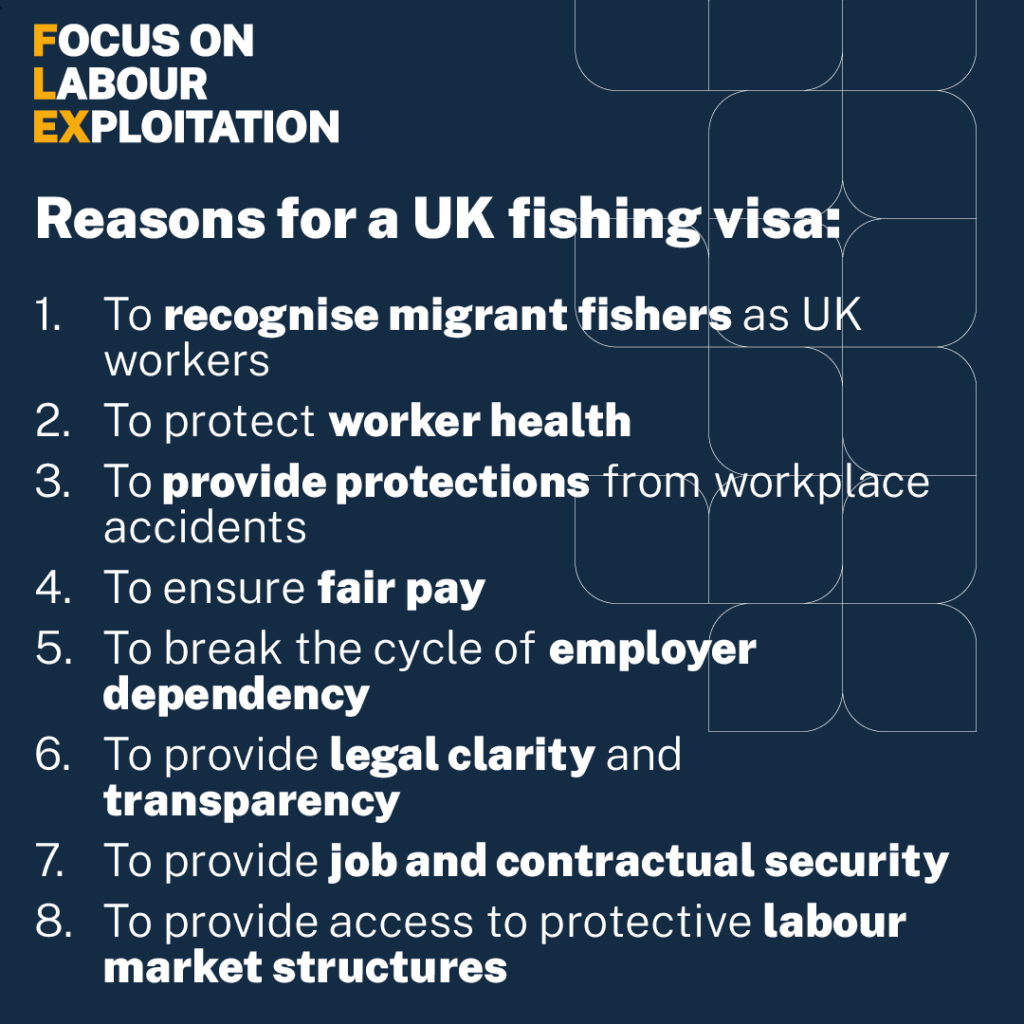
In FLEX’s report “Voices from the Deck: The Workers’ Rights Case for a UK Fishing Visa“, you can read what they have to say for themselves.
“It depends on the catch […] Sometimes, ma’am, we go without sleep for 36 hours. Sometimes, we rest for 1 hour [during that time]. Especially when it’s the season for prawns.”
Nonoy, Filipino fisher (17 years in the UK)
“The weather alone, it was so cold… It took me a month to recover. We’re always wet, especially during bad weather. You have to put up with it because you’re looking for work. It’s hard when you don’t have money.”
Pedro, Filipino fisher (13 years in the UK)
“The foreign crew said they admired me because even when I was vomiting all over the place, I still did my work.”
Jojo, Filipino fisher (3 years in the UK)
“Our employer changed the terms of the contract because our work schedule there was not the same, the work was unlimited. There’s no time to rest… In our case,
we didn’t have a weekend at all. Even if we’re in the harbour, we were still working.”
Ricardo, Filipino fisher (12 years in the UK)
From unfeasible working hours without rest, to extreme weather conditions, to contractual grey areas perpetuating risks of exploitation, the experiences migrant fishers tell us must inform urgent policy decisions.
This timely report threads these experiences together, to show that vulnerability comes from the structures themselves.
To address these systemic risks, we present the case for a dedicated UK fishing visa which enables migrant fishers to access rights as workers in practice.
Read the report, and get in touch if you have any questions or can help bring attention and urgent change on this vital issue.
Secure Reporting
This month, FLEX’s Head of Policy Kate Roberts spoke at the Fair Work Agency’s Working Lives Conference at UCL, where “Working Lives: the scale and nature of labour market non-compliance and other work-based harms in the UK” was launched. FLEX was also pleased to contribute to the report.
In discussions, it was clear how important Secure Reporting is to ensure the Fair Work Agency lives up to its potential.
Secure Reporting is a set of principles, practices and procedures which ensure that when people report being a victim or witness of a crime to a public authority their personal data is not shared with the Home Office or Immigration Enforcement.
The sharing of personal data with the Home Office can have serious and far-reaching consequences for people with insecure immigration status. It can and does lead to victims being detained, removed, or deported, or to children being separated from their families and placed into care.
As a result, many people with insecure immigration status are deterred from reporting crimes or safeguarding concerns—such as labour abuse, modern slavery, trafficking, forced labour, debt bondage, wage theft, unsafe working conditions and sexual exploitation. These fears are actively exploited by perpetrators, who use the threat of deportation or immigration enforcement as a tool of control.
The Fair Work Agency must create secure reporting pathways so that all workers, including migrant workers, can access help for employment matters, without worrying about their immigration status.
This new briefing, compiled by the Labour Exploitation Advisory Group, gives a summary of what Secure Reporting is and why it’s so desperately needed.

Earned Settlement Reforms: How Keeping Workers Temporary Drives Exploitation
The Government’s proposed “Earned Settlement” reforms are framed as changes to immigration policy, grounded in concerns about integration and the fiscal impacts of immigration.
However, the reforms, if implemented, will have significant consequences for the UK labour market. By extending the time migrant workers are required to remain in temporary immigration status, they will drive up levels of labour exploitation and weaken labour standards.
These outcomes not only pose serious concerns regarding people’s access to rights, including employment rights in the UK, but also undermine the stated aims of the Government’s reforms. Evidence shows that prolonged immigration insecurity reduces economic progression, weakens labour market enforcement, and creates barriers to integration.
This briefing highlights our learnings from workers with short term and restrictive immigration status as a projection for the impacts of the government’s proposed changes to settlement and related immigration rules.
Read the Parliamentary Briefing here.
Not signed up to the FLEX Newsletter? Click here