

April 2026 Newsletter: What the Fair Work Agency launch means for workers
28/04/2026
At the start of April, the Fair Work Agency launched. This is simultaneously an important achievement after years of work, and an essential opportunity that can’t be squandered.
For years, labour market enforcement functions have been spread across departments and agencies. FLEX, alongside numerous organisations, have called for a single enforcement body like the Fair Work Agency for years. By merging labour enforcement authorities into one body, it makes it easier for workers to navigate and enforce their rights. This is a real landmark.
But to be effective, the Fair Work Agency must ensure that all workers can report problems in practice. One in five UK workers was born abroad; migrants make up a huge part of the workforce. The Fair Work Agency therefore needs secure reporting practices put into place, so migrant workers are able to report exploitation without the risk of having their information shared with authorities.
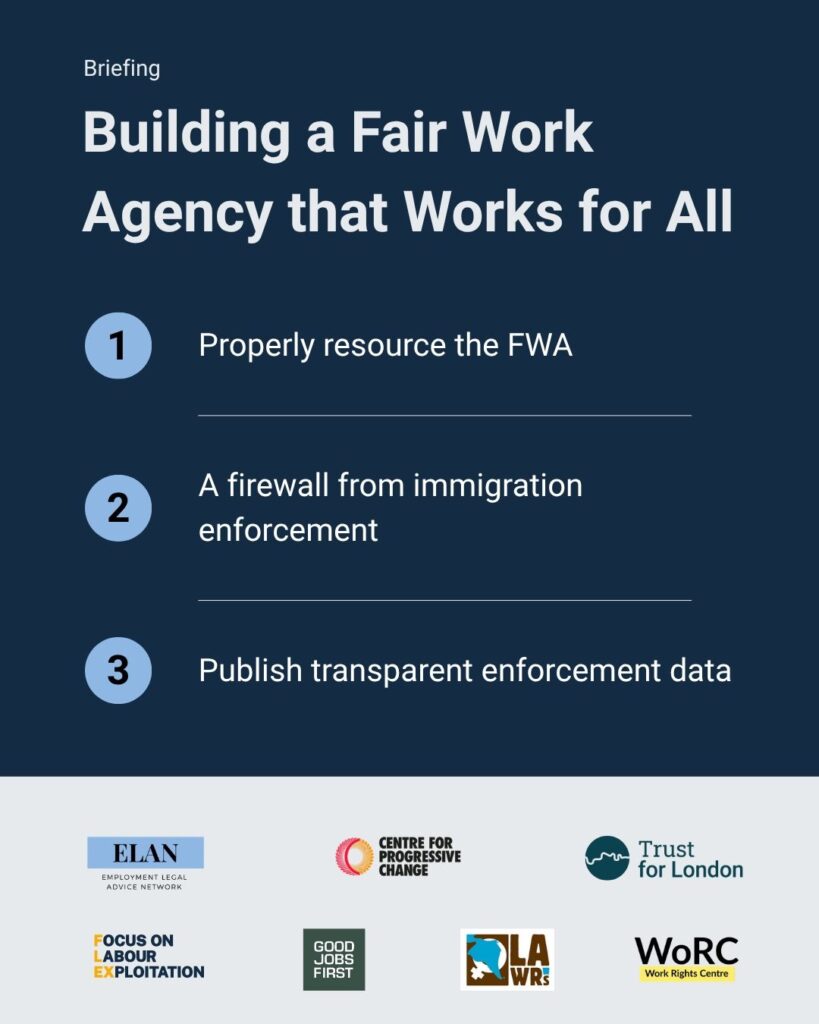
It is essential that it also has the resources, powers, understanding and implementation to regulate effectively. FLEX has joined the calls to properly resource the agency, and to publish transparent enforcement data, covering inspection activity, enforcement actions, sector-specific patterns and the balance between proactive and reactive work. We joined a sector-wide call for these essential measures, which can be read here.
As the Fair Work Agency begins to take shape in practice, we are determined to ensure it takes the necessary steps, and is provided the necessary means, to be an important tool for workers to challenge exploitation in practice.
Dignity after Insourcing: Rethinking workplace inequality in due diligence

Insourcing is often treated as a corrective to outsourcing in public services and low-wage work. When services are brought back in-house, the assumption is that inequality has been addressed through a change in employment status.
But the shift in legal employer does not necessarily resolve how work is organised, valued, and experienced on the ground.
Across cleaning work in UK public institutions, insourcing has delivered clear improvements. Workers have moved from outsourced contracts into direct employment, with gains in hourly pay, sick pay, holiday entitlement, and pension access. In some cases, long-standing gaps in basic employment conditions have been reduced or removed.
These changes matter. They alter the baseline security of work that had previously been structured around subcontracting models that fragment responsibility and spread accountability across multiple actors, making it harder to identify who is responsible for working conditions. They also show what becomes possible when workers challenge outsourcing and secure direct employment.
At the same time, evidence from these workplaces points to gaps that remain. Insourcing does not always remove the workplace hierarchies that determine how different kinds of work are valued and workers are treated.
Cleaning remains a form of “dirty work” within institutional life — necessary but invisible.
In practice, insourced workers often occupy a space that is formally integrated but socially separated. The boundary is no longer external (outsourced versus in-house), but internal (core versus peripheral work). Understanding and addressing this gap matters both for workplaces that have already achieved insourcing and for efforts to improve conditions across outsourced service models more broadly.
Read our latest blog on the real benefits and important limitations of inhousing, and what needs to be done moving forwards.

New briefing:
Precarious by design: How the Seasonal Worker Scheme can drive irregularity

If we were to play a board game where the rules were outright broken, we wouldn’t blame the players; we’d rightfully blame the game itself.
So if “irregularity” means failing to meet the demands of the visa rules and immigration system, then we must look at the rules themselves to see how reasonable and feasible they are.
In Focus On Labour Exploitation (FLEX)’s latest briefing, ‘Precarious by design: How the Seasonal Worker Scheme can drive irregularity‘, we analyse how irregularity is directly connected to the government’s design of migration routes.
The result is clear: the rules themselves increase the risks of exploitation for workers, and take away vital options to access decent work and enforce rights in the UK.
FLEX Research Manager Oliver Fisher wrote a piece for Free Movement’s blog, unpacking the report which you can read here.
To read the full briefing, click here.
In Case You Missed It:
Fair for all Workers: How learning from Australia’s Workplace Justice Visa can support access to workers’ rights in the UK
Alongside the Fair Work Agency, the UK government has promised that the Employment Rights Act would bring about the biggest upgrade to workers rights in a generation.
However, the UK’s reliance on restrictive work visas, which limit the options of workers to bring complaints against an employer on whom they also depend for their immigration status, undermines these ambitions and hampers the ability of the Fair Work Agency to meaningfully enforce workers’ rights.
In July 2024, Australia started piloting a bridging visa that allows people on temporary visas, who have experienced exploitation at work, to stay in the country for up to 12 months in order to work and seek redress for their exploitation.
Together with other Labour Exploitation Advisory Group members, we have pulled out key learnings from Australia’s experience.
The UK would be wise to build on these learnings to inform and implement its own Workplace Justice visa to ensure all workers can access employment rights in practice. This could make all the difference for the Fair Work Agency, and workers facing risks of exploitation.
Not signed up to the FLEX Newsletter? Click here