


Amos Mhando
September 2026 Newsletter: Workers’ experiences are shaping our work
29/09/2026
Amos Mhando
Latest Updates
We’re excited to announce a new partnership

Reporting abuse should never place a worker at even greater risk.
That is why FLEX is excited to announce a new partnership with Voice of Domestic Workers and CAS Analytics, exploring how reporting abuse or exploitation can be made safer and fairer for migrant domestic and horticulture workers.
Using Feminist Participatory Action Research, we will work alongside peer researchers with experience in these sectors. Workers will help shape the research questions, collect evidence, develop recommendations and advocate for change.
Together, we will investigate what prevents workers from reporting problems, where they feel safe seeking support and what safeguards they need to speak up without risking their employment, income or immigration status.
We will also explore how trust can be built in reporting mechanisms and emerging enforcement structures, including the Fair Work Agency.
This is not simply research about workers. It is research shaped and led by their knowledge, priorities and experiences.
FLEX research informs APPG action plan on fishing

A call for a fishing workers visa that recognises migrant fishers as workers.
The All-Party Parliamentary Group on Fisheries has published an Action Plan for the UK fishing industry. FLEX has long highlighted the misuse of the seafarers “transit loophole” and called for a fishing workers visa that recognises migrant fishers as workers. Planned changes after December 2026 could make the Skilled Worker route inaccessible to migrant fishers, increasing reliance on the loophole and the risk of exploitation.
Our “Unravelling the Nets” report is cited in the APPG Action Plan discussion supporting Recommendation 17 on fishing visa reform. The evidence session where FLEX presented the research is also listed among the parliamentary sessions that helped shape the Action Plan.
This matters. The immigration rules affecting migrant fishers are not a technical side issue: they directly affect whether workers can access their rights, challenge exploitation and seek justice.
We will continue pushing for a visa system that protects migrant fishers rather than increasing their vulnerability.
The Immigration and Asylum Bill must be amended to avoid exploitation
FLEX and partners have set out their concerns to Parliament.
Despite the UK government’s stated commitments to tackling modern slavery and strengthening employment rights and labour market enforcement, the Immigration and Asylum Bill poses a serious risk to victims and survivors of labour exploitation. In its current form the Bill will weaken the UK’s system for identifying and supporting victims of modern slavery, while including provisions which will drive individuals into exploitative work. Combined with wider immigration policy, including the increased use of restrictive work visas, existing hostile environment policies and the proposed changes to settlement policy, we will see growing numbers of workers with significant vulnerabilities to exploitation and limited practical ability to challenge abuse.
FLEX and others are working to secure positive changes to the Bill, to work towards an immigration system which increases access to rights. We are also deeply critical of measures in the draft Bill which should be removed or amended.
Together with the Labour Exploitation Advisory Group (LEAG) and the Detention Taskforce, we set out our concerns in written evidence to the Public Bill Committee and the Joint Committee on Human Rights.
Groundhog Day? Government has heard the evidence—now it must act
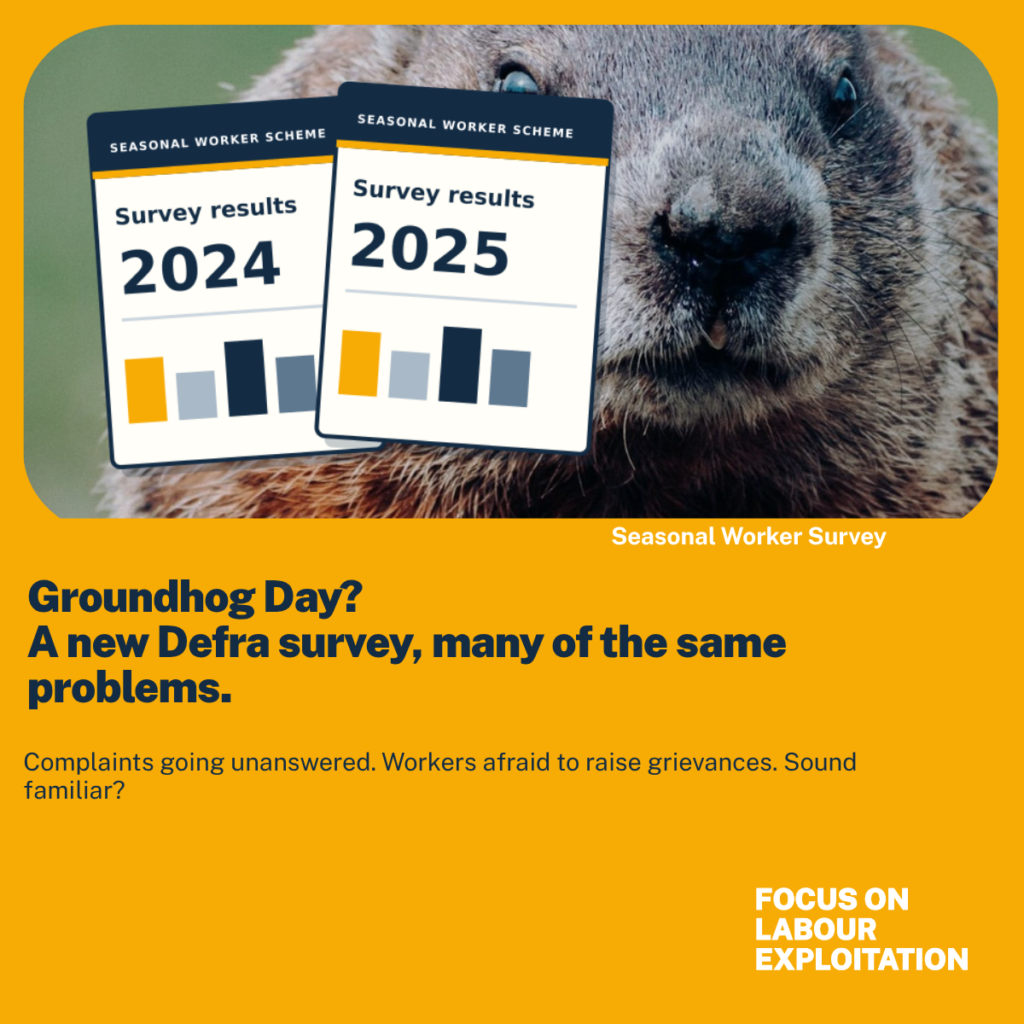
Defra’s annual survey asks people who worked in the UK on Seasonal Worker visas about their experiences, including pay, living conditions and complaints. The latest results show that many of the same serious problems remain.
- Around three in ten workers who complained said their complaint was not followed up.
- Only 16% of workers who experienced a grievance made a formal complaint.
- Workers feared losing their jobs, not being invited back or that nothing would be done.
Workers have provided the evidence. Again.
The UK Government must now act to dismantle the policies that create risks for workers on the scheme. Workers need safe and effective ways to report problems, complaints that lead to action and working and living conditions that meet decent standards.
They should not have to report the same problems year after year while waiting for meaningful change.
Recent coverage in The Grocer, featuring comments from FLEX, also highlighted why the Seasonal Worker Scheme remains high risk for workers.
Join our upcoming events
This week, join us for two free online events exploring how workers can report exploitation safely, pursue justice and shape the decisions affecting their working lives.
Webinar: Justice for All Workers: Learning from Australia’s Workplace Justice Visa
Tuesday 29 September 2026 9.30am-11.00am (BST)
In this webinar, co-hosted by FLEX and the Trades Union Congress, we will hear about the implementation of the Workplace Justice Visa in Australia and discuss how creating a UK Workplace Justice Visa could ensure that workers experiencing labour exploitation can report abuse, change employers and pursue workplace justice without risking the loss of their immigration status and permission to work.
Our expert panel will also explore the broader role that the visa could play in strengthening workers’ rights, labour market enforcement and trade union organising.
Webinar: A seat at the table? Lessons from testing worker-centred human rights due diligence in outsourced services
Wednesday 30 September 2026 10.00am-11.00am (BST)
Over five years, FLEX has worked alongside workers, businesses, suppliers and civil society organisations to test what it takes to put workers at the centre of human rights due diligence (HRDD) in outsourced service supply chains.
Join us for a free one-hour webinar to launch our new learning report and hear what we learned from putting worker-centred HRDD into practice.
We will share practical examples from the project, including what worked, what challenged our assumptions, what we changed along the way and what we would do differently.
Not signed up to the FLEX Newsletter? Click here