

June 2026 Newsletter: Time For Honesty
29/06/2026
Time for honesty: a broken workforce strategy and reliance on migrant workers
With major changes happening at the very highest level of government, it is an important moment to pause and reflect on recent policy developments impacting on workers and migrant rights.
Last year, the government passed the Employment Rights Act and a new Immigration Bill is expected as we write. Yet significant issues remain with the UK’s model of restrictive and short-term visas and reliance on migrant workers for key sectors including care, agriculture and fishing.
The next weeks will be a time of political change. This should also be an opportunity for the UK to rethink our broken migration strategies and make sure our immigration laws and policies ensure that employment rights can be accessed by all workers.
Read our full statement reflecting on the latest developments in government and FLEX’s blueprint for safe and fair migration.
Standing in solidarity and hope

International Domestic Workers Day 2026
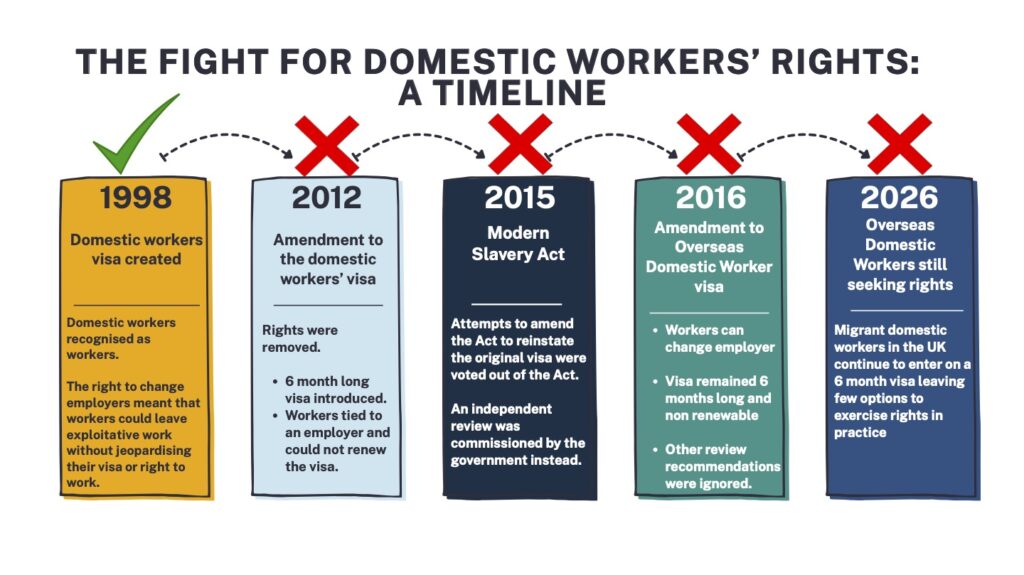
On 14 June, more than 200 people united in Central London in joyful celebration and recognition of the invaluable contributions of migrant domestic workers and their determination to fight for dignity and justice.
The annual event, co-organised by The Voice of Domestic Workers, Kalayaan and Focus on Labour Exploitation (FLEX), opened with a rally at Parliament Square followed by a family picnic event including a program of speeches, music and dance.
The event came two days after an informative webinar hosted by Freedom United, exploring the realities and repercussions of the UK’s overseas domestic worker visa. The webinar included expert insights from the UK Independent Anti-Slavery Commissioner, Eleanor Lyons, in conversation with workers, on their long-standing campaign to change the rules and empower workers to access rights in practice, building on lived experiences of of the broken promises and life under current visa rules.
International Justice Day for Cleaners and Security Guards 2026
This International Justice Day for Cleaners and Security Guards, we took time to reflect on and recognise the workers who keep buildings running, safe, and operational every day. We know that much of their experience is shaped behind the scenes, in how services are contracted, procured, and managed across outsourced service sectors. That distance between visible work and contracting decisions is where working conditions are often set.
Our recently published Worker-Centred Model provides a new approach to human rights due diligence in service supply chains. The model has been carefully co-created with workers to surface risks that traditional approaches often miss, and to help companies respond earlier and more effectively.
Through this work, we’ve seen how worker insight can shift understanding in very practical ways, from wage implementation and lone working safeguards to how rest breaks and daily conditions are actually experienced.
Safe Harbour: Dismantling the Legal Fiction of the Transit Loophole
For nearly two decades, the UK fishing industry has relied on a legal fiction to staff its fleets.
In a new piece for the UK Labour Law Blog, FLEX Research Officer, Angeli Romero, examines the “transit loophole” – a mechanism that treats migrant fishers as if they are merely “in transit” through the UK, despite working continuously on British vessels.
Rooted in a statutory exemption under the Immigration Act 1971, this loophole effectively strips these workers of formal legal standing in the UK. Drawing on findings from our recent “Voices from the Deck” report, the blog details how the transit loophole facilitates a system of structural vulnerability, locking migrant fishers out of domestic labour rights protections and state enforcement mechanisms.
It also explores the limitations of the current Skilled Worker Visa route, the implications of the government’s planned immigration reforms, and why the sector urgently needs a fit-for-purpose visa that protects workers while supporting the long-term sustainability of the fishing industry.
Coming soon: FLEX’s Supplier Engagement guide to help businesses address hidden risks
When we work with businesses that are starting to look at outsourced services like cleaning, security, facilities management, or logistics, one question comes up time and time again:
“We know there are risks we can’t see – but how do we engage suppliers in a way that builds trust rather than resistance?”
In the coming weeks, we’ll be publishing a practical guide on supplier engagement in outsourced service sectors. Because before any meaningful worker engagement can happen, there are important foundations to establish with suppliers.
Drawing on years of practical experience, testing, and learning alongside buyers, suppliers, and workers, it explores what effective supplier engagement looks like in practice- and where businesses can start.
Outsourced services are often treated as “non-core”, yet they are essential to day-to-day operations and service quality. These sectors also rely on migrant and minority workers, with workforce risks remain largely unmapped and hidden within complex contracting arrangements.
Once you understand how services are actually delivered, working together to identify and address risks becomes much easier.
Stay tuned for further details on the upcoming launch of our new Supplier Engagement Guide.

Not signed up to the FLEX Newsletter? Click here